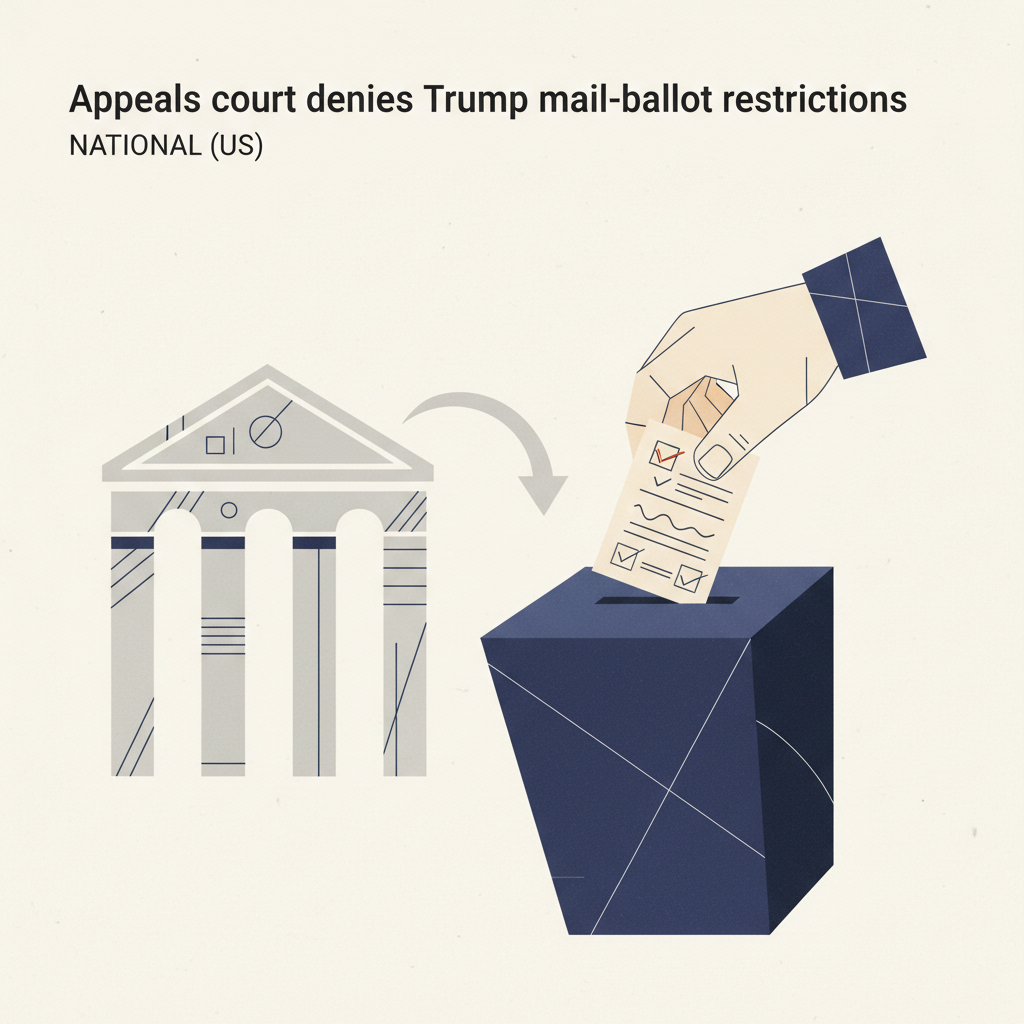
•An appeals court denied the administration’s mail-ballot restrictions.
•The ruling concerns election administration, not a candidate race.
•The administration did not obtain the court approval it sought.
•The decision is a judicial action, not a new law.
An appeals court denied the Trump administration’s effort to impose restrictions involving mail ballots. The decision blocks the administration from obtaining approval for those restrictions through this court action.
The development concerns how elections are administered, not a candidate contest or the outcome of a particular election. It is a court decision about an election policy advanced by the administration.
What the court decided
The appeals court rejected the Trump administration’s effort to secure mail-ballot restrictions. That means the administration did not obtain the appeals-court decision it sought.
The ruling should be read narrowly. It addresses the restrictions that were before the court and the administration’s attempt to have them approved through that proceeding. It does not represent a vote by Congress, a state legislature or the public.
The decision also does not determine the winner of an election or favor a candidate. No candidate or specific race is directly connected to the case. Its immediate importance is instead in election administration: the federal government sought restrictions affecting mail ballots, and the appeals court denied that effort.
Why the decision matters
Mail-ballot rules determine how election officials handle ballots submitted outside an in-person polling place. A court decision involving restrictions can therefore affect the instructions and standards used to administer voting.
In this instance, the appeals court did not authorize the Trump administration’s restrictions. The ruling draws a line between the administration’s election-policy goals and what it was able to secure from the court.
For voters, the key point is straightforward: the administration sought limits involving mail ballots, but the appeals court did not allow that effort to succeed in the proceeding before it. The decision is about the legal authority to impose those restrictions, rather than a general judgment about whether voters should choose to vote by mail or in person.
What the ruling does not do
The court’s decision does not create a campaign platform, endorse a political party or settle a candidate race. It is a judicial action concerning government policy and election procedures.
The ruling also should not be treated as a complete description of every mail-voting rule. Election procedures can include multiple requirements, and this decision concerns the Trump administration’s restrictions that reached the appeals court. Voters still need to follow the official voting rules that apply to them.
The denial does not itself amount to a new law enacted by lawmakers. Instead, it means the administration failed to obtain approval for its restrictions from the appeals court in this action.
What comes next
Attention now turns to the legal process after the denial. Further filings could clarify whether the administration will continue pursuing the restrictions through another court action or leave the appeals-court decision in place.
Election officials may also issue guidance explaining how the decision affects their work. Any such instructions would be important for showing how the ruling is applied in practice and whether it changes administrative steps involving mail ballots.
For voters, official election notices remain the practical source for deadlines, ballot-return instructions and other requirements. The appeals-court decision establishes that the administration’s restrictions were denied, while later legal or administrative steps may determine how the dispute proceeds.
What to watch
•Any further court filings by the administration
•Guidance from election officials
•Additional proceedings concerning the restrictions