
News · MD
What Maryland voters will decide in the 2026 election
Elections and votingMaryland’s 2026 ballot includes races for governor, attorney general and all eight U.S. House seats.
The Ballot Maryland Policy DeskOct 5, 2026
News · Elections and voting · Maryland
A judicial ruling has stopped a Democratic effort to change Maryland’s electoral district boundaries from advancing as proposed.
Key takeaways
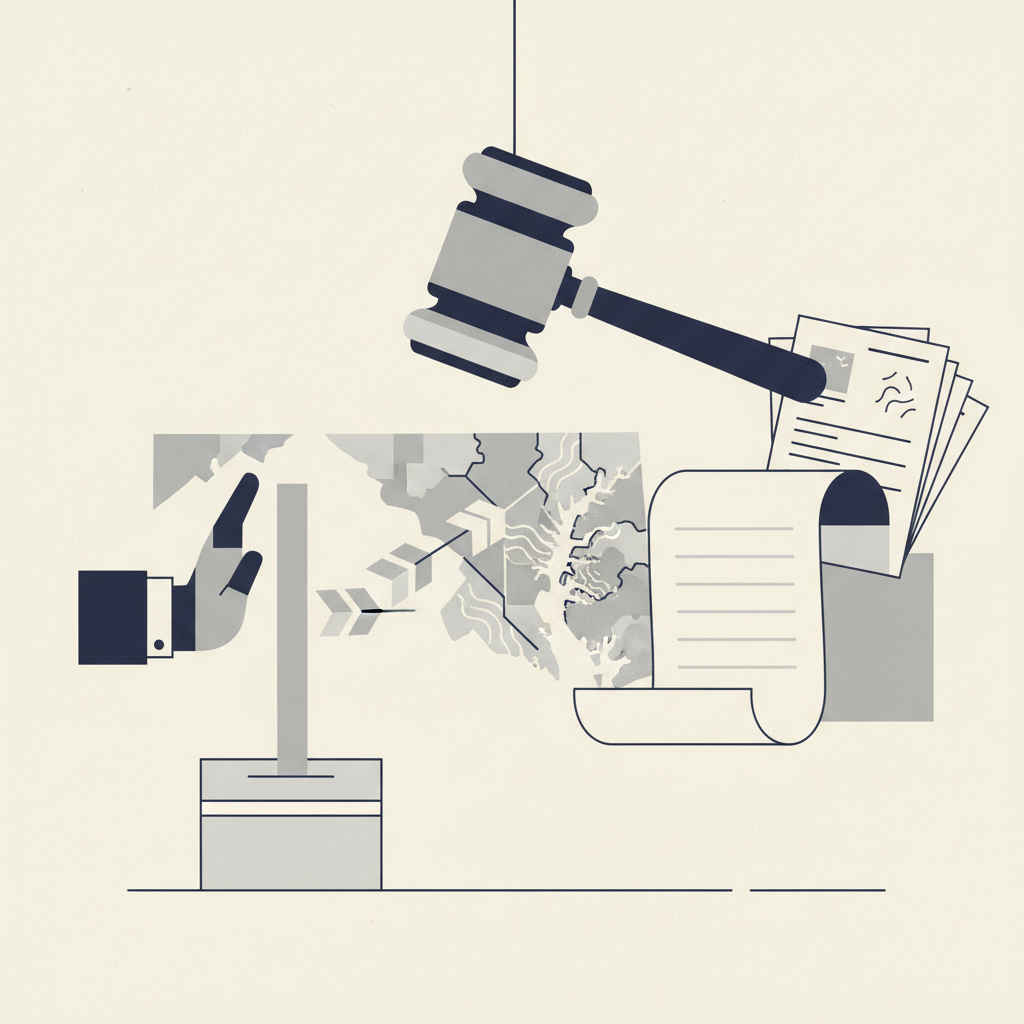
A judge has blocked a Democratic push to redraw electoral district boundaries in Maryland. The decision places a legal barrier in front of the effort and prevents it from advancing along its proposed path.
The ruling concerns the rules and procedures for changing district boundaries. It does not decide an election, resolve a contest between candidates or determine which party will hold office.
The direct effect is that the Democratic redistricting push cannot proceed as proposed. A redistricting plan does not become effective simply because political officials support it; it must also satisfy the legal requirements governing how district boundaries may be changed.
A judicial block interrupts that process. It does not, by itself, create a different set of boundaries. Unless the legal posture changes or officials pursue another valid course, the blocked effort remains unable to move forward on its planned route.
The decision therefore shifts the immediate focus away from the proposed boundary changes and toward the next procedural step. That could involve further court action, a revised approach or a decision not to continue the effort.
Redistricting is the process of revising the boundaries that divide voters into electoral districts. Those lines determine which voters are grouped together for representation and which district contests appear on a voter’s ballot.
Because district boundaries shape how communities are organized for elections, changes can have effects beyond the lines shown on a map. A new boundary may place a voter in a different district or change which communities vote together for a particular office.
The Maryland ruling does not select officeholders or determine how anyone must vote. Its immediate significance is procedural: the court has stopped this particular effort to change the boundaries.
Describing the proposal as a Democratic push identifies the political group behind the effort. It does not turn the court’s ruling into a victory for a candidate or a forecast of a future election result.
No specific candidate race or election is directly connected to this development. The central issue is whether and how Maryland’s district boundaries may be changed through the state’s legal and political processes.
That distinction matters for voters following redistricting disputes. Political officials may advocate for new boundaries, but courts can review actions that are challenged and can prevent a plan or process from advancing. Here, the judge’s intervention has halted the Democratic effort at its current stage.
The next development will depend on how supporters of the redistricting effort respond to the ruling. Further legal proceedings could address the block, while a different proposal could raise a new set of procedural questions.
Until another action changes the situation, the judge’s decision remains the controlling development for this push. Voters can watch for formal court filings, any revised redistricting plan and announcements from the officials involved in Maryland’s mapmaking process.
Those steps would determine whether the effort remains halted, changes form or returns for additional legal review. None of those possible procedural paths determines an election outcome on its own.
What to watch
Was this useful?
News · MD
Maryland’s 2026 ballot includes races for governor, attorney general and all eight U.S. House seats.
News · MD
Maryland is adding guardrails for data centers as more states respond to the industry’s fast expansion.
News · MD
Question 3 would ease constitutional limits on congressional maps but would not change districts for the 2026 midterm election.
News · MD
The Supreme Court of Maryland returned a redistricting referendum to the November ballot, allowing voters to decide the measure.